In this post
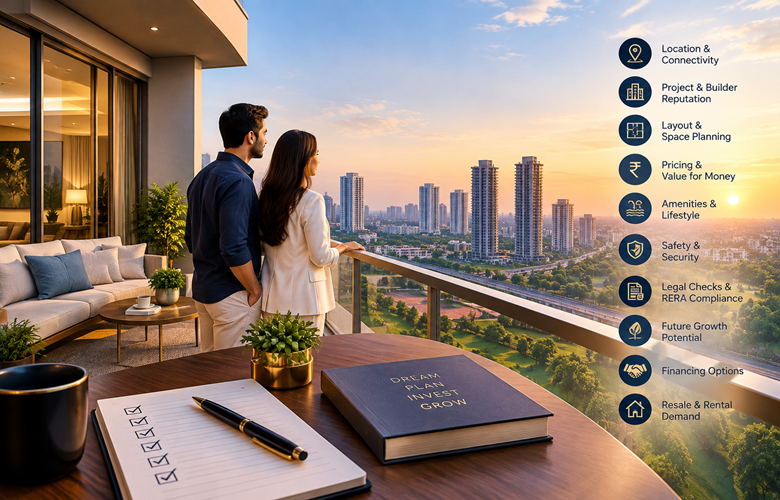
- Things to Check Before Buying a Luxury Flat in Gurgaon, Step by Step
- HRERA Registration Check for a Gurgaon Project
- Builder Buyer Agreement Clauses Worth Reading Twice
- Hidden Costs of Buying a Flat in Gurgaon at ₹5 Crore
- Gurgaon Collector Rates 2026 and Your Stamp Duty
- Low Density Luxury Apartments in Gurgaon: The Homes Per Acre Test
- Developer Track Record: Occupation Certificates Over Sample Flats
- Our Advisory Desk on ₹5 Crore Site Visits
- Tarc Ishva Sector 63A Against the Checklist
- Key Takeaways Before You Book
- FAQs
Before buying a ₹5 Crore+ Apartment in Gurgaon, check 6 things in this order: the project’s Haryana RERA (HRERA) registration and filings, the builder-buyer agreement, the all-in cost, the collector rate, the homes-per-acre density, and the developer’s delivery record. That final cheque changes the budget first. A male buyer pays 7 percent stamp duty, or ₹35 lakhs, plus a ₹50,000 registration fee. An under-construction flat adds 5 percent GST, or ₹25 lakhs more. That takes a ₹5 crore price to about ₹5.6 crore before interiors, parking or club charges.
Quick Snapshot
- The HRERA project page shows the registration certificate, declared completion date and construction updates. Read it before any token payment.
- RERA caps advance collections at 10 percent of the price until the sale agreement is registered.
- On ₹5 crores, stamp duty is ₹35 lakhs for a man and ₹25 lakhs for a woman, and the registration fee stops at ₹50,000.
- GST of 5 percent applies only to under-construction homes. A flat with an occupation certificate attracts no GST.
- Home loans above ₹75 lakhs are limited to 75 percent of the value, so a ₹5 crore purchase needs ₹1.25 crore or more from your savings.
- Gurugram’s revised collector rates took effect on 1 April 2026, with hikes of 15 to 75 percent across sectors.
Things to Check Before Buying a Luxury Flat in Gurgaon, Step by Step
Gurugram’s top end is busier than ever. The city recorded about 1,494 sales of homes priced at ₹10 crores and above in 2025, worth roughly ₹24,120 crores, and HRERA Gurugram approved 51 new projects in the first half of 2026. More launches mean more brochures that say the same thing. The order in which you check things protects your money.
Price comes last on this list, and that is deliberate.
- Regulatory filings: registration certificate, approvals, and quarterly progress reports.
- The agreement for sale: carpet area, payment triggers, delay and defect clauses.
- The full cost: stamp duty, registration fee, GST and TDS.
- The collector rate for the sector you are buying in.
- Density: registered homes divided by site acres.
- Delivery record: occupation certificates on the developer’s finished projects.
HRERA Registration Check for a Gurgaon Project
Every group housing project in Gurugram sold before completion has to be registered with the Haryana Real Estate Regulatory Authority. Its project page lists the registration certificate, the developer-declared completion date, the approved building plan, the DTCP license, and the quarterly progress reports.
Three entries on that page decide more than any sales pitch:
- The declared completion date. Delay compensation under the RERA Act is counted from this date, so a verbal promise of an earlier handover has no legal weight.
- Quarterly progress reports. They show the construction stage against the money collected, and a wide gap between the two deserves a direct question.
- Addendums. When a project adds land or towers, the developer files an addendum. Match your tower number to the registered plan before paying.
RERA also requires developers to deposit 70 percent of buyer collections into a separate project account, used only for construction and land cost. Ask which bank holds it. A clear answer takes seconds.
Builder Buyer Agreement Clauses Worth Reading Twice
The RERA Act’s Section 13 bars a developer from taking more than 10 percent of the apartment cost as an advance or application fee before signing a registered agreement for sale. A plan that asks for 20 percent at booking fails that test on day 1.
Once the draft agreement arrives, read these parts slowly:
- Carpet area. RERA defines it as the net usable floor area inside the external walls, excluding service shafts, exclusive balconies, and open terraces. The agreement must state it. Our explainer on super area and carpet area shows how far the 2 figures can drift apart.
- Payment triggers. In a construction-linked plan, each installment should match a stage you can confirm in the progress reports.
- Delay terms. Section 18 lets you claim interest for every month of delay, or exit with a full refund plus interest.
- Defect liability. Under Section 14(3), the developer must fix structural defects and workmanship faults you report within 5 years of possession, free of charge.
- Add-on charges. Parking, club membership, power backup, and maintenance deposits should each appear as a rupee line item, never as “as applicable”.
Hidden Costs of Buying a Flat in Gurgaon at ₹5 Crore
The sticker price is only the opening number. For a ₹5 crore purchase in an urban Gurugram sector, the statutory costs work out like this:
- Stamp duty: 7 percent for a man (₹35 lakh), 5 percent for a woman (₹25 lakh) and 6 percent for joint ownership between a man and a woman (₹30 lakh). It is charged on the agreement value or the circle rate value, whichever is higher.
- Registration fee: capped at ₹50,000 for any property valued above ₹90 lakhs.
- GST: 5 percent (₹25 lakh) on an under-construction home, with no input tax credit. A completed home with an occupation certificate attracts no GST.
- TDS: you deduct 1 percent (₹5 lakh) from what you pay the seller and deposit it against the seller’s PAN within 30 days from the end of that month. It is not an extra cost, though a late deposit attracts interest.
Loan planning changes too. Banks cap lending at 75 percent of the property value on loans above ₹75 lakhs, and they exclude stamp duty and registration from that calculation. At this price, that means at least ₹1.25 crore of your own money, plus the stamp duty and registration fee.
Registering in a woman’s name saves 2 percent, which is ₹10 lakhs at this price.
Gurgaon Collector Rates 2026 and Your Stamp Duty
Gurugram’s revised collector rates, also called circle rates, took effect on 1 April 2026, with increases between 15 and 75 percent depending on the sector. Sectors along Golf Course Extension Road were among the pockets that saw sharper revisions.
The rate matters because stamp duty and the 1 percent TDS both use the higher of your agreement value and the collector rate value. On most new luxury sales, the agreement value is higher. On a discounted resale deal, the circle rate can set the tax floor instead, so check the figure for your exact sector in the district’s final 2026 to 2027 list.
Low Density Luxury Apartments in Gurgaon: The Homes Per Acre Test
Luxury Apartments in Gurgaon, Brochures use “low density” freely. You can test the claim in 30 seconds: divide the number of homes registered with HRERA by the site area in acres. Both numbers appear on the regulator’s project page.
At this ticket size, a lower result usually means fewer families per lift core, less pressure on clubhouse bookings and parking, and more open ground between towers. Look at 3 related numbers while you are there:
- Towers and floors, which show how the homes are stacked.
- Homes per floor per core, which decides how many families share each lift lobby.
- Open faces per home. Four-side-open layouts get daylight and cross-ventilation from every side, a difference our four-side-open comparison guide covers in detail.
Developer Track Record: Occupation Certificates Over Sample Flats
A sample flat proves design skill. An occupation certificate proves delivery.
Ask for the OCs on the developer’s last 2 or 3 finished projects and compare each handover with the completion date first declared to HRERA. The authority’s complaint and order records show whether buyers have taken the developer to the regulator, and on what grounds. Listed developers also report sales, collections, and project milestones to the stock exchanges every quarter, giving you a public timeline to test promises against.
Our Advisory Desk on ₹5 Crore Site Visits
Most buyers at this budget arrive with the floor plan memorized and the regulator’s page unopened. We reverse that order. Before any token payment, we ask to see 3 documents: the registration certificate, the latest quarterly progress report and the draft agreement for sale.
Then we do the arithmetic on paper. A family comparing 2 towers in the same project tends to focus on floor level and view. We put stamp duty, GST, parking and club charges next to each option, and seeing both all-in totals together turns a question of views into a question of value.
On site, we walk the fire exits, count lifts per core, and stand on the balcony at the hour the family will use it most. A brochure cannot show afternoon glare or noise from the main road. A visit at the right hour can.
“At ₹5 crores, the brochure is the least important document you will read. The regulator’s page and the agreement decide what you actually own.”
Tarc Ishva Sector 63A Against the Checklist
This project makes a useful test case because its paperwork is public. TARC Limited launched Tarc Ishva on Golf Course Extension Road in September 2024 and reported sales of about ₹1,350 crores, roughly half the project as it then stood, by late November 2024. Its HRERA registration number is RC/REP/HARERA/GGM/865/597/2024/92.
Running it through the 6 checks:
- Registration and addendum: an HRERA addendum in January 2026 expanded the site to 9.1405 acres.
- Scale: in March 2026 TARC unveiled Ishvara, the sixth and tallest tower, taking the plan to 6 towers and 518 residences across about 1.7 million sq.ft. of development.
- Density: 518 homes on about 9.14 acres works out to roughly 57 homes per acre.
- Layout and access: every residence is four-sided open, with entry from 84-meter and 24-meter-wide roads.
- Delivery record: TARC received the occupation certificate for TARC Tripundra in Delhi and began handovers there in FY2026.
For floor plans, registered project details, and inquiries about TARC Ishva Gurgaon.
Key Takeaways Before You Book
A ₹5 crore decision in Gurugram is won or lost on paperwork and arithmetic, long before the site visit.
- Read the HRERA project page first: registration, declared completion date, progress reports, and any addendum.
- Hold payments to 10 percent until the sale agreement is registered, and get the carpet area in writing.
- Budget about ₹60.5 lakh over a ₹5 crore under-construction price for a male buyer, and keep ₹1.25 crore or more ready as your share of the loan.
- Divide registered homes by acres to test any low-density claim. Tarc Ishva Gurgaon Sector 63A comes in at about 57 homes per acre.
When you are ready, share the tower and floor you are considering through the inquiry form, and our team will walk you through the full cost.
Read more: https://www.tarcishvagurgaon.in/blog/
FAQs
What should I check before buying a 5 crore apartment in Gurgaon?
Start with the project’s HRERA registration, declared completion date and construction progress filings. Then read the sale agreement for carpet area, payment triggers and delay terms. Next, work out the all-in cost, including stamp duty, registration and GST. Finish with the sector’s circle rate, homes per acre and the developer’s occupation certificates on finished projects.
How much stamp duty is payable on a ₹5 crore flat in Gurgaon?
You pay 7 percent, or ₹35 lakhs, if the flat is registered in a man’s name. A woman buyer pays 5 percent, or ₹25 lakhs, and joint ownership between a man and a woman costs 6 percent, or ₹30 lakhs. The registration fee is capped at ₹50,000. Duty applies on the higher of agreement or circle rate value.
Is GST charged on a ready-to-move luxury flat in Gurgaon?
No. GST applies only to under-construction homes, at 5 percent without input tax credit for flats outside the affordable category. Once the developer receives the occupation certificate and you buy a completed home, you don’t pay GST. You still pay stamp duty, the registration fee and the 1 percent TDS on purchases of ₹50 lakhs and above.
How can I verify the HRERA registration of a Gurgaon project?
Search the project name or registration number on the Haryana RERA Gurugram website. The project page shows the registration certificate, declared completion date, approved plans, license details, and quarterly progress reports. Match the developer name, tower numbers, and site area with your booking documents. Get any mismatch resolved in writing before you pay.
How much can a developer collect before the agreement for sale?
Under Section 13 of the RERA Act, a developer cannot take more than 10 percent of the apartment cost as an advance or application fee before signing a registered agreement for sale. At a ₹5 crore price, that limit is ₹50 lakhs. A booking plan that asks for more before registration breaks this rule.
How do I calculate the density of a housing project?
Divide the total number of homes registered with HRERA by the site area in acres. The result is homes per acre, a quick check on any low-density claim. Then look at towers, floors, and homes per core. Together, these numbers show how many families will share lifts, parking, and clubhouse facilities daily.
How much own money do I need for a ₹5 crore home loan?
Banks can lend up to 75 percent of the property value on any loan over ₹75 lakhs, so you need at least ₹1.25 crore of your own funds for this budget. Stamp duty and the registration fee also come from savings, since lenders leave them out when they calculate the eligible loan amount.
What can I claim if the developer delays possession?
Section 18 of the RERA Act gives you 2 choices. You can stay in the project and claim interest for every month of delay until possession, or withdraw and get your full amount back with interest. The delay is measured against the completion date declared to HRERA, not the date quoted in marketing material.
What is the HRERA registration number of Tarc Ishva Sector 63A?
The registration number is RC/REP/HARERA/GGM/865/597/2024/92. TARC Limited is developing the project on Golf Course Extension Road, and a January 2026 addendum expanded the site to 9.1405 acres. The plan now includes 6 towers and 518 residences. You can see floor plans, registered details,